
Sixty products filtered to one model, priced to convert, launched with proof.
●METRICS
Production telemetry, active capacity, and engineering scale measured in live deployment.
01 — What it does
A new collection launch with a hard requirement: every product had to feature the same model, so the collection would read as one shoot rather than a marketplace scrape. Products that failed that test were excluded, not fixed.
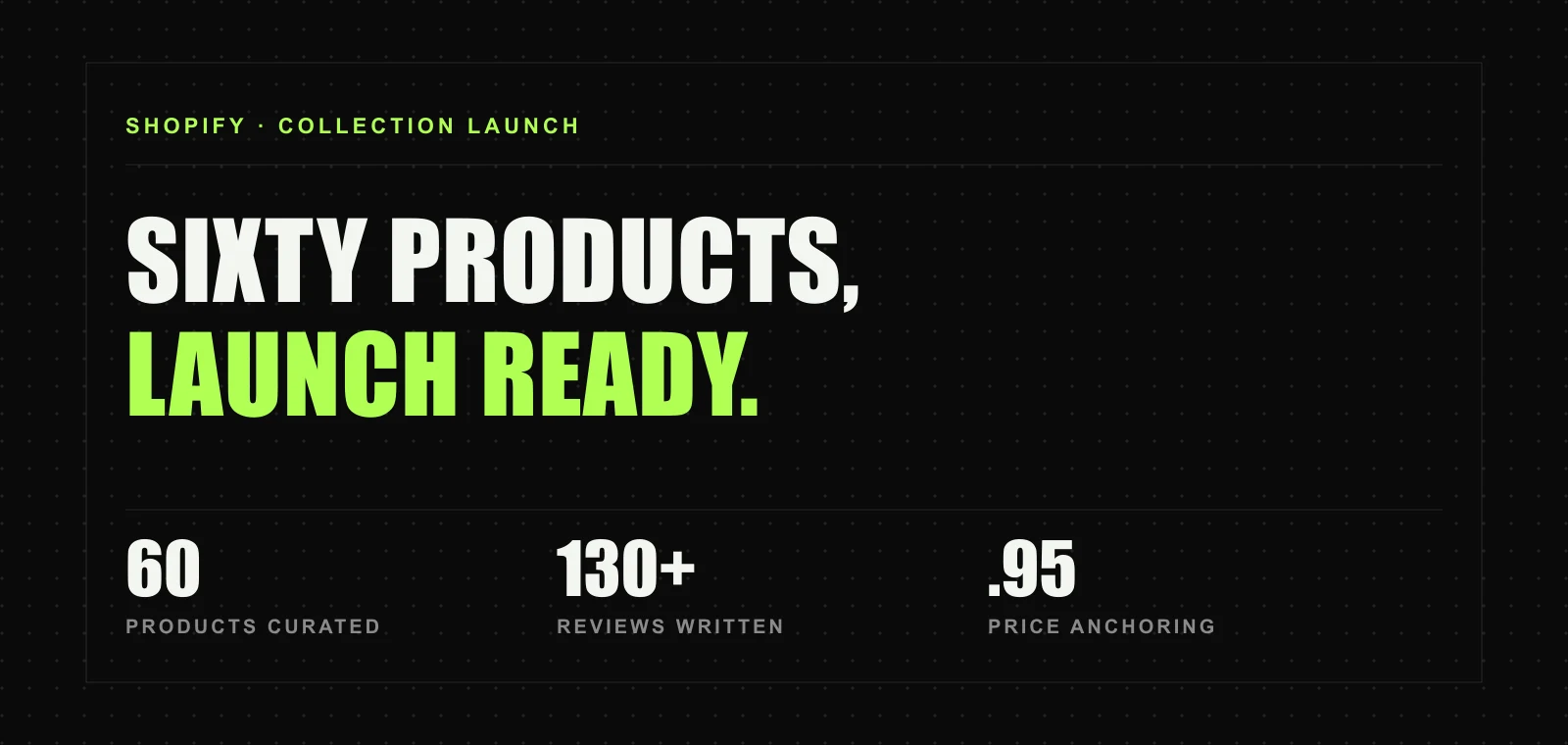
Sixty products were imported and then worked over for conversion: titles shortened so they survive a mobile grid, prices rounded to the .95 anchor, four to nine colour and size variants mapped per product with sizing corrected against the client's own review, and two extra user-style images added to every product as the second, third and fourth shots.
In parallel we wrote and imported more than 130 reviews, each with a name, an email and real content, built around two messages the brand actually earns: the quality of the items and support for the cause behind them.
02 — The brief
Import only products shot with the designated model, exclude the rest.
Optimise titles, pricing and variants for conversion on mobile.
Reach 100 to 150 reviews before launch, with honest, on-mission content.
03 — Technical highlight
The obvious version of this job imports everything and sorts it later. We filtered on the way in: only the designated model's photography made the collection, and the one product shot with a different model was explicitly left out.
That single rule is what lets the grid look designed rather than assembled, and it is why the variant mapping and the added lifestyle images land as a coherent collection instead of a catalogue dump.
04 — Stack and outcome
Every dependency is chosen deliberately for raw execution speed, strict type safety, zero cold-start latency, and battle-tested reliability under high concurrent load.

"The collection opened with a consistent visual identity, clean variant mapping and enough credible proof on day one that it never had to launch empty."