
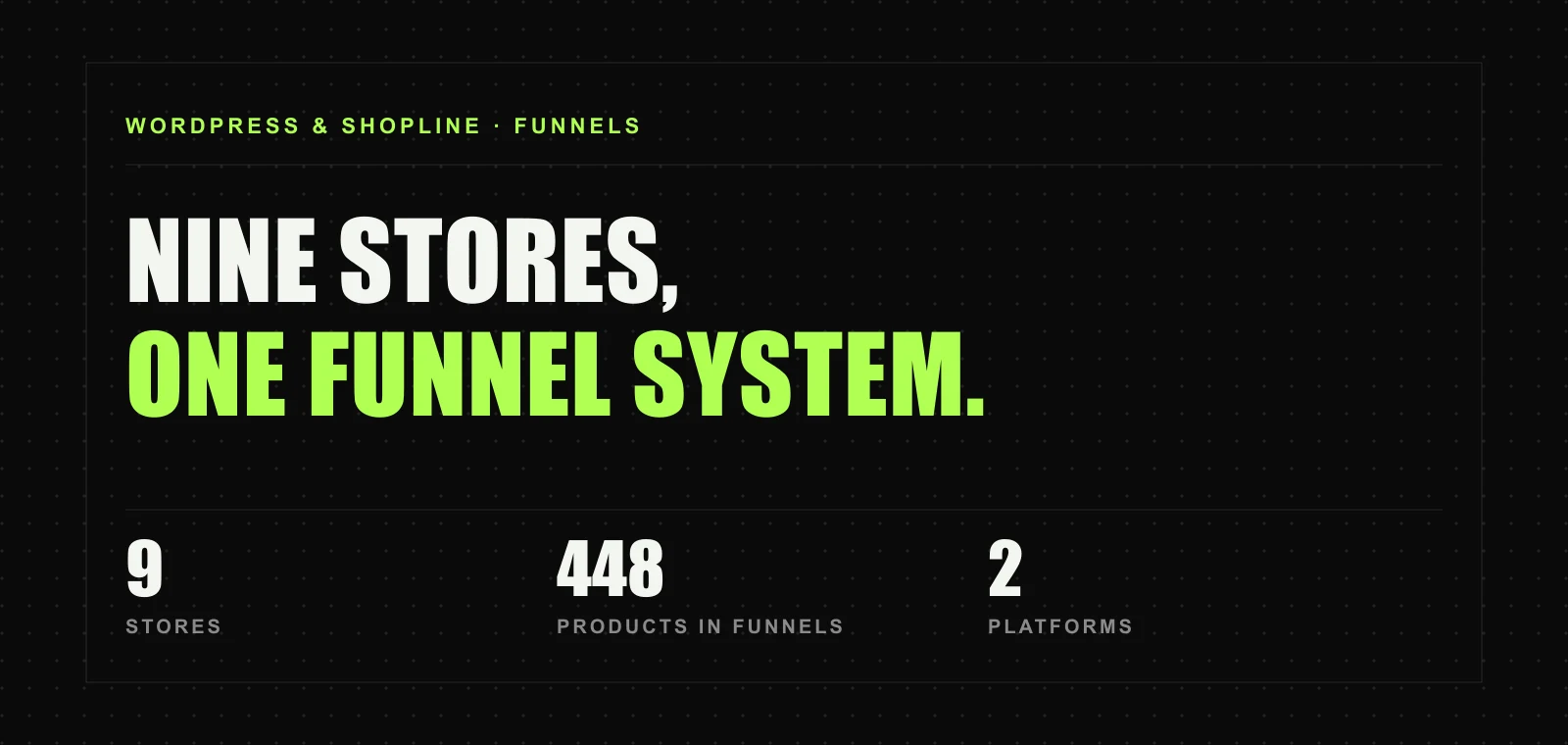
One funnel template, nine stores, two platforms, 448 products.
●METRICS
Production telemetry, active capacity, and engineering scale measured in live deployment.
01 — What it does
Nine storefronts across Poland and the Netherlands, all needing the same thing: a funnel that could carry their own branding without being rebuilt nine times.
We designed one funnel template with dedicated slots for logos and a feature image, localised it for the Polish store, then cloned and re-branded it across eight Dutch stores, adjusting logos, buy buttons, footer content and brand sections per store. Between them the funnels carry 448 products.
Around that sat the store work itself: product pages imported into each theme with formatting that matched it, two price-point collections (185 euro and 135 euro) designed and populated then replicated across three stores, and twenty-five products for a Shopline storefront scraped by hand from listing URLs because that was the only source the client had.
02 — The brief
One funnel design that works for a Polish store and eight Dutch ones.
Product pages imported to each store's theme with the right formatting.
Collections built around price points and replicated across stores.
03 — Technical highlight
The cost in a job like this is not the first funnel, it is the ninth. So the first one was built as a template: logo slot, feature image slot, and the brand sections isolated where they could be swapped without touching the layout.
Every store after that was a clone plus a re-brand rather than a build, which is what made nine stores across two platforms possible inside a month.
04 — Stack and outcome
Every dependency is chosen deliberately for raw execution speed, strict type safety, zero cold-start latency, and battle-tested reliability under high concurrent load.

"Nine stores running the same funnel system in their own branding, on two platforms, inside a single month."